

Cloud Transformation & How It Supports Business Growth

What is Cloud Transformation?
Cloud transformation is the process of moving IT infrastructure, applications and data from on-premises systems to scalable cloud environments. It helps businesses improve performance, reduce costs and scale more efficiently.
For CTO’s and IT leaders, it is not just a technical upgrade, it is a strategic shift in how technology supports business growth.
In practise, cloud transformation involves:
- Migrating workloads, applications and data to the cloud
- Replacing fixed infrastructure with scalable environments
- Creating a more secure cloud architecture
- Supporting long-term business continuity and resilience
It also includes cloud application transformation, where legacy systems are modernised to perform effectively in cloud environments. This allows for faster updates, improved performance and easier scalability.
To see how this works in practice, explore Viatel’s cloud transformation solutions
Why Cloud Transformation Matters for Businesses
Cloud transformation has become a core requirement as organisations increasingly rely on SaaS platforms, hybrid working and distributed teams.
For businesses operating across multiple locations, flexibility and secure access are essential. Cloud infrastructure supports this while enabling long-term growth.
Cost optimisation
- Reduce spend on physical infrastructure
- Move to predictable operational cost models
- Scale resources based on real demand
Performance and agility
- Faster deployment of applications
- Improved system responsiveness
- Reduced downtime across core platforms
Business continuity and resilience
- Built-in redundancy across cloud environments
- Faster recovery in the event of disruption
- Reduced risk across operations
Flexibility for modern working
- Secure access from any location
- Consistent performance across multiple sites
- Support for hybrid and remote teams
The result is a more adaptable IT environment that supports both day-to-day operations and long-term growth. This is reflected in real-world outcomes, from organisations like BowelScreen Ireland improving secure access to critical systems, to St. Francis Credit Union successfully migrating core applications to Microsoft Azure, and IRP Commerce scaling its platform to support growth through cloud infrastructure.
Read more about how Viatel leveraged Microsoft Azure to help BowelScreen analyse its data.
Private Cloud vs Public Cloud: What’s the Difference?
Public Cloud uses shared infrastructure and is highly scalable and cost efficient.
Private Cloud offers dedicated resources with greater control and security.
Choosing the right type of cloud infrastructure is a key step in any cloud transformation journey. Each model offers different advantages depending on your requirements for control, scalability and cost.
A third option, virtual private cloud, creates an isolated environment within a public cloud, offering a balance between flexibility and security.
The key differences are outlined below:
Feature | Public cloud | Private cloud |
Infrastructure | Shared | Dedicated |
Cost structure | Lower upfront | Higher upfront |
Control | Limited | Full control |
Scalability | Very high | Moderate |
Security | Standard | Customisable |
Deployment speed | Fast | Slower |
In reality, most organisations use a mix of both depending on their needs.
What is a Hybrid Cloud Approach?
A hybrid cloud approach combines on-premises infrastructure, private cloud environments and public cloud services into a single, connected system.
This allows organisations to:
- Move workloads based on performance or cost
- Maintain control over sensitive data
- Scale efficiently without full migration
It is particularly valuable for organisations with legacy systems, as it supports integration rather than replacement, making cloud transformation more achievable over time.
Hybrid cloud is particularly suited to:
- Organisations with existing infrastructure that cannot be replaced immediately
- Businesses with strict compliance requirements
- Companies managing variable or unpredictable workloads

Understanding Virtual Private Cloud (VPC)
A Virtual Private Cloud (VPC) is a secure, isolated environment within a public cloud platform.
It allows organisations to build private networks while still benefiting from the scalability of shared infrastructure.
Key benefits include:
Isolation
- Keeps workloads separate from other tenants
- Reduces exposure within shared environments
Enhanced security
- Custom firewalls and network configurations
- Greater control over data movement
Flexible resource allocation
- Scale up or down based on demand
- Support evolving workloads without disruption
This model is widely used in enterprise environments, particularly on platforms like Microsoft Azure. Learn more about Viatel’s Azure cloud solutions here
The Role of Colocation in Cloud Transformation
Colocation plays an important role in many cloud transformation strategies, particularly where full migration to the cloud is not immediately possible.
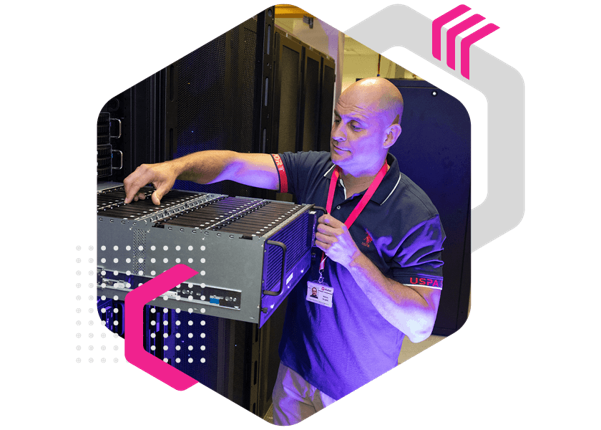
It involves hosting your physical infrastructure in a secure, third-party data centre while connecting it directly to cloud platforms. This provides a stable foundation for hybrid cloud environments.
Colocation supports cloud transformation by:
- Providing direct connectivity to public and private cloud platforms
- Enabling low-latency performance between systems
- Supporting gradual workload migration
Organisations benefit from:
- Security: Enterprise-grade facilities with strict access controls
- Reliability: High availability with redundant systems
- Connectivity: Seamless integration with cloud providers
For businesses managing legacy systems alongside modern platforms, colocation acts as a bridge between traditional infrastructure and cloud environments.
Explore Viatel’s colocation solutions here
Flexible Cloud Solutions for Growing Businesses
As organisations grow, their IT requirements become more complex. Static infrastructure can lead to inefficiencies, overprovisioning or performance bottlenecks.
Flexible cloud environments are designed to adapt in real time, allowing businesses to scale resources in line with demand.
This is particularly valuable for:
- Organisations experiencing rapid growth
- Businesses with seasonal or variable workloads
- Teams launching new digital services
Key capabilities include:
- On-demand scaling of compute and storage
- Dynamic allocation of resources
- Consistent performance under changing conditions
Viatel’s FlexiCloud solution is built around this principle, offering scalable cloud infrastructure across Viatel’s own private data centres as well as Microsoft Azure and AWS. This multi-cloud capability gives organisations the flexibility to design a hybrid cloud strategy that balances performance, cost and control, while ensuring seamless integration across environments.
Learn more about FlexiCloud here
Cloud Application Transformation
Cloud application transformation focuses on modernising applications so they can fully leverage cloud infrastructure. Rather than simply moving systems unchanged, it involves redesigning them to improve performance, scalability and integration.
Moving legacy systems to cloud-native environments allows applications to run more efficiently in modern cloud infrastructure, removing the limitations of outdated architectures. This shift improves performance and scalability by enabling systems to handle increased demand, scale resources dynamically and deliver a more consistent user experience.
This can involve rehosting or rebuilding applications as cloud-native solutions.
The benefits are significant:
- Faster deployment: Release updates quickly with reduced disruption
- Improved performance: Optimised for scalable cloud environments
- Better user experience: Faster response times and improved reliability
- Enhanced security: Built into modern cloud architecture
For many organisations, this is where cloud transformation delivers its most visible impact, as seen in projects such as IRP Commerce’s Azure scaling, where application performance and growth capacity improved significantly.
Choosing the Right Cloud Strategy for Your Business
Cloud transformation is not just about selecting the right technology. It requires a clear understanding of how infrastructure decisions will impact performance, security and long-term scalability. Many organisations underestimate the complexity of workload migration, integration and ongoing management, which can lead to inefficiencies if not properly planned.
A structured approach helps reduce risk and ensures that each part of the environment is aligned with business priorities. This includes assessing which workloads should move first, identifying dependencies between systems and designing a secure cloud architecture that supports both current and future needs. Working with an experienced partner can simplify this process and provide a clearer roadmap for transformation.
Before making decisions, it is important to assess:
Current IT environment
- Existing systems and dependencies
- Readiness for migration
Security and compliance needs
- Data protection requirements
- Industry regulations
Scalability requirements
- Growth projections
- Application demands
Budget considerations
- Cost structure and planning
- Balance between capital and operational spend
A simple way to map priorities to solutions is shown below:
Business priority | Recommended approach | Why it works |
Rapid scaling | Public cloud | High elasticity |
High security needs | Private cloud | Greater control |
Mixed environments | Hybrid cloud | Balanced flexibility |
Legacy system integration | Hybrid with colocation | Gradual transition |
Secure scalability | Virtual private cloud | Isolation with flexibility |
Start Your Cloud Transformation Journey
The key point is that cloud transformation should align with your broader digital transformation strategy. It should enhance resilience, improve performance and support future growth without introducing unnecessary complexity.
Viatel works as a consultative partner, helping organisations design tailored cloud environments that meet their specific needs.
Cloud transformation is not a one-size-fits-all journey.