


Network & Connectivity Solutions for Business in Ireland
Why Network Connectivity Matters for Modern Irish Businesses
In the modern business world, getting “online” is a basic prerequisite for day-to-day operation. For Irish organisations, the quality, resilience and performance of their underlying connectivity infrastructure determines how effectively they can compete, scale and secure themselves.
This comprehensive guide explores the essential network and connectivity solutions available to businesses in Ireland.
For Irish businesses, choosing the right connectivity strategy is no longer just an IT decision, it directly impacts performance, security, costs and scalability.
Check your connectivity performance in seconds with our Connectivity Checker.
What are Network & Connectivity Solutions?
Network and connectivity solutions refer to the infrastructure and technologies that enable seamless communication across your organisation. They connect employees, offices, cloud platforms, and data systems into a single, high-performing environment.
Rather than a single solution, it is a sophisticated combination of technologies designed to ensure seamless data flow.
Key components of a modern network may include:
- Fibre, Radio & Satellite: These are the primary types of connections used to physically deliver primary and back up internet services to businesses depending on their location and requirements.
- Dedicated Internet Access (DIA): Private uncontended internet connection for high-performance needs.
- Wireless Broadband: High-speed radio or cellular-based connectivity, often used for redundancy or rapid deployment.
- SD-WAN: Software-defined wide area network management that optimises traffic across multiple links.
- Network Security: Integrated protections that safeguard data as it moves across these connections.
Connectivity is effectively the central nervous system of your company. When this foundation is weak, every other digital tool, from CRM systems to video conferencing, suffers.
Conversely, a well-architected network design and resilience strategy directly enhances productivity, minimises downtime and provides a scalable structure for future growth.
Explore Viatel Technology Groups: Network & Connectivity Solutions
Why Network Connectivity Matters for Modern Irish Businesses
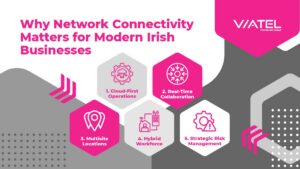
The business landscape in Ireland has shifted. The move toward hybrid work and cloud-first operations has fundamentally changed the demands placed on corporate networks.
Modern organisations now rely heavily on:
1. Cloud-First Operations
Whether it is hosting data in Azure or AWS or using SaaS platforms like Salesforce, the cloud is where business happens. If the connection to the cloud is slow or unstable, work effectively stops.
2. Real-Time Collaboration
Microsoft 365, Teams and high-definition video conferencing are non-negotiable tools. These applications require high bandwidth and, more importantly, low latency to function without lag or jitter.
3. The Multi-Site and Hybrid Reality
With regional offices across Ireland and employees working from various locations, the network must be able to bridge these gaps securely. Low-latency connectivity isn’t a luxury; it is a requirement for maintaining a unified workforce.
4. Strategic Risk Management
Poor connectivity leads to downtime, which carries a heavy price tag in lost revenue and damaged reputation. Furthermore, an unsecured network is a prime target for cyber attacks. Connectivity must be viewed as a strategic business decision that mitigates these risks.
Fibre Broadband vs Business Broadband: What’s the Difference?
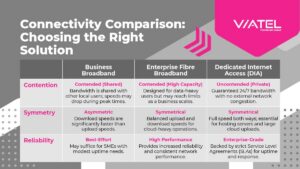
While often used interchangeably, standard business broadband and enterprise-grade fibre broadband offer very different levels of performance, reliability and scalability.
Standard Business Broadband
Standard business broadband is typically an asymmetric service, where download speeds are significantly higher than upload speeds. It also operates as a contended connection, meaning bandwidth is shared with other users in the local area.
As network demand increases during peak periods, this can result in slower speeds and inconsistent performance. For smaller SMEs with lighter usage, such as basic browsing, email or limited cloud access, this level of connectivity is often sufficient.
Enterprise Fibre Broadband
By contrast, full-fibre broadband delivers higher reliability and significantly faster, more consistent speeds, often with symmetrical upload and download capabilities.
This makes it particularly well suited to growing or data-intensive organisations that rely on cloud platforms, video conferencing, large file transfers or real-time applications. With improved stability and reduced contention, fibre supports stronger network performance and uptime, ensuring business operations run smoothly.
Key Comparison Points:
- Contention: Shared vs. dedicated resources.
- Symmetry: Balanced upload/download speeds for cloud-heavy users.
- Reliability: Uptime and response times in case of a fault.
As a business scales, even high-end fibre broadband may reach its limits, necessitating a transition to more robust uncontended solutions like DIA.
View our Business Broadband options
What Is Dedicated Internet Access (DIA)?
For enterprises where connectivity is mission-critical, Dedicated Internet Access (DIA) is the gold standard. Unlike shared broadband, DIA internet provides a private fixed connection between your business and the service provider.
Why Choose DIA?
- Guaranteed Uncontended Bandwidth: You receive the exact amount of bandwidth you pay for 24/7, regardless of local traffic.
- Predictable Performance: DIA offers the low-latency connectivity required for real-time applications like VoIP and video conferencing.
- Strict SLAs: These services come with robust Service Level Agreements, guaranteeing specific uptime and response times.
- Symmetrical Speeds: Essential for businesses that push large amounts of data to the cloud or host their own servers.
DIA is enterprise-grade connectivity providing peace of mind with the assurance that a business will never be slowed down by external network congestion.
Learn more about Dedicated Internet Access (DIA).
How SD-WAN Improves Network Performance & Resilience
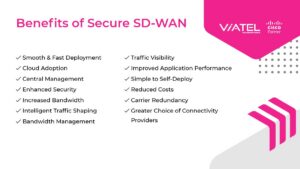
As businesses become more complex and distributed, traditional wide area networks (WANs) can become rigid and expensive. SD-WAN solutions (Software-Defined Wide Area Network) offer a modern alternative by using software to manage traffic across multiple network links.
Key Benefits of SD-WAN:
- Visibility and Control: IT teams gain a “single pane of glass” view into how the network is performing across all branches.
- Hybrid Work Support: It is the ideal solution for companies with multisite offices or those supporting a hybrid work environment.
- Resilience: If one connection fails, SD-WAN seamlessly shifts traffic to another ensuring zero downtime.
- Performance Optimisation: It automatically routes critical traffic over the best performing link while sending less critical data (like an email) over a standard connection.
Discover SD-WAN Solutions
Security and Connectivity Go Hand in Hand
In the modern threat landscape, network security Ireland cannot be an afterthought, it must be built into the fabric of your connectivity. Every connection point is a potential gateway for a cyber-attack.
The Integrated Security Approach:
- Secure Gateways: Filtering traffic at the very edge of your network to block threats before they reach your internal systems.
- Network Segmentation: Keeping guest Wi-Fi, devices and critical internal data on separate logical paths to prevent lateral movement by attackers.
- Proactive Monitoring: Constant surveillance of network traffic to identify and mitigate unusual patterns.
By framing security as a “built-in” component rather than a “bolt-on” addition, Irish businesses can ensure their secure connectivity supports both productivity and compliance.
Explore our Cybersecurity Solutions
Choosing the Right Network & Connectivity Solution
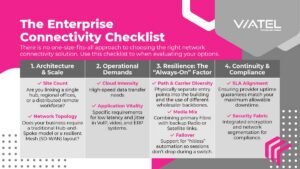
There is no one-size-fits-all approach to connectivity. When evaluating your options, use this checklist to determine your “solution-fit”.
1. Architecture
- Number of Sites: Do you need to link multiple regional offices, a central hub, or a distributed remote workforce?
- Topology: Does your layout favour a traditional Hub-and-Spoke model or a more resilient Mesh (SD-WAN) architecture.
2. Operational Demands
- Cloud Usage: How much of your daily operation relies on real-time cloud access and high-speed data transfer?
- Performance Requirements: What are the specific latency, jitter, and throughput needs for your critical applications (eg VoIP, Video, ERP)?
3. Resilience & Redundancy (The “Always-On” Factor)
- Path Diversity: Do your backup links enter the building through the same conduit as the primary? (True resilience requires physically diverse entry points).
- Carrier Diversity: Are you using different networks for primary and backup to protect against a single wholesaler’s backbone outage?
- Failover Automation: Does your hardware support “hitless” failover, or will sessions drop and require manual reconnection during a switch?
- Media Diversity: Are you mixing technologies? (eg fibre for primary, with radio or satellite for backup)
4. Continuity & Recovery
- SLA Alignment: Does your provider’s Service Level Agreement (SLA) match your business’s Maximum Allowable Downtime
5. Security & Compliance
- Data Protection: Does your industry require specific encryption (A or segmented network access for compliance (PCI, GDPR)?
- Integrated Security: Are security protocols maintained consistently when the network switches to a backup path?
Viatel Technology Group acts as a consultative partner, helping you design a bespoke architecture that balances performance with budget.
FAQs
1) What connectivity solution is best for growing businesses in Ireland?
For most growing businesses, a mix of high-speed Fibre Broadband or DIA is recommended to ensure scalability and reliability as headcount and cloud usage increase.
2) What’s the difference between business broadband and dedicated internet access?
Business broadband is a shared (contended) service with variable speeds while DIA is a private uncontended connection with guaranteed speeds and enterprise-grade SLAs.
3) When should a company consider SD-WAN?
SD-WAN is ideal for companies with multiple locations, a high reliance on cloud applications or a need for better visibility and resilience across their network links.
4) Is wireless broadband reliable enough for business use?
Yes, modern business-grade wireless broadband is an excellent solution for areas without fibre or as a high-speed failover option to ensure constant uptime.
5) How does network connectivity impact security and performance?
A well-designed network reduces latency and uses integrated security features like encrypted tunnels and firewalls to protect data without slowing down your operations.