


Building Ransomware Resilience
When (Not If) It Happens, Will You Be Ready?

The call comes at 2:47 AM. Your CISO’s voice cuts through the silence: “We have been hit.” In the next 30 minutes, you’re about to learn what ransomware resilience really means when everything is on the line and whether years of cybersecurity investments were worth it.
The New Reality: Assume Breach
Organizations must now assume breach. This assumption is not mere pessimism. It is an operational reality in a threat landscape where ransomware has evolved from a fringe risk into a mainstream, sophisticated, and increasingly automated operational threat.
Today’s attackers do not just want money. They want operational paralysis. Threat actors are moving faster, targeting critical infrastructure, and shifting from simple extortion to full-scale disruption. The threat model has evolved from “can we get in?” to “how quickly can we shut you down and how much of your sensitive data can we steal and monetize?”
Industry consensus has shifted: it is no longer a matter of if you will be attacked, but when.
Taking the inevitability factor into account, ransomware resilience requires more than attempting to prevent an attack. A resilient cyber defence demands a layered approach that also prioritizes attack containment and rapid recovery of data and operations to maintain business continuity.
Where Most Organizations Get It Wrong
The most common mistake organizations make is focusing exclusively on prevention. Firewalls, EDR/XDR, and backups are essential, but they will not stop an attack that has already breached the perimeter.
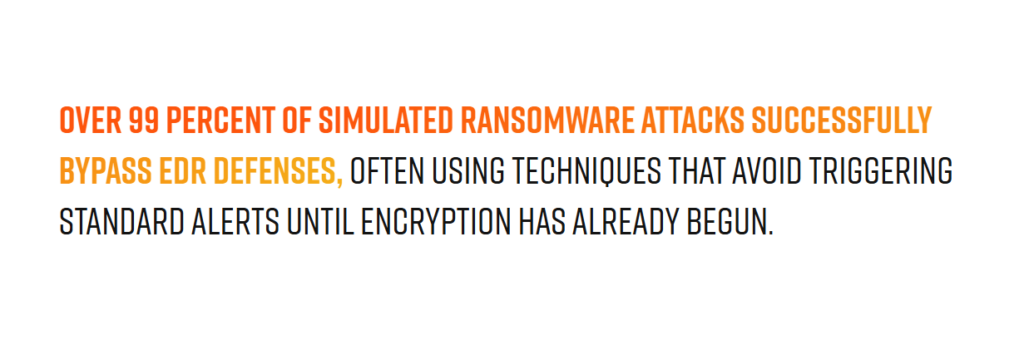
True ransomware resilience requires more than blocking threats at the gate. It requires a containment layer that automatically halts encryption in progress, allowing you the time to recover. Without it, prevention tools may slow an attacker, but they will not stop the damage.
Three Windows Where Resilience Is Decided
Every ransomware attack follows a predictable lifecycle: the Cyber Kill Chain. Understanding these stages reveals three critical windows where organizations either contain the threat or suffer catastrophic damage.
Window 1: The Intrusion
During the delivery and exploitation phases, attackers gain initial access through phishing, stolen credentials, or exposed services. Most organizations have no idea they have been compromised.
The unprepared: Are unaware that cybercriminals are moving laterally across their network, performing reconnaissance and disabling security protocols.
The resilient: Detect unauthorized access early and know containment will stop encryption if attackers reach critical systems.
Window 2: The Dwell Time
Dwell time is the most dangerous window. Attackers spend days, weeks, or even months installing tools, establishing command-and-control, mapping the network, and targeting backups. The average dwell time gives attackers ample opportunity to position themselves for maximum damage.
The unprepared: Discover too late that attackers have disabled backups, compromised credentials, and positioned ransomware across their entire infrastructure.
The resilient: Monitoring detects anomalies during this phase, and containment stands ready to halt encryption the moment it begins.
Window 3: The Encryption
When attackers execute their final objective, encryption spreads across the network in minutes. Some ransomware variants can encrypt 250,000 files in under five minutes. The encryption phase usually determines the severity of the outcome.
The unprepared: Watch helplessly as malware encrypts tens of thousands of files, face weeks of downtime, and scramble for answers when stakeholders demand them.
The resilient: Sub-second containment stops encryption within milliseconds, limiting damage to only a few dozen files. IT restores this handful of files while business continues. Automated logs provide audit-ready documentation for regulators and insurers.
Why Traditional Defenses Fall Short
The AI Acceleration Factor
Artificial Intelligence (AI) is fundamentally accelerating the threat landscape. According to Cyble, U.S. ransomware attacks increased by 149% year-over-year in the first five weeks of 2025, with 378 reported incidents compared to 152 in 2024.
AI-driven malware can morph code to avoid detection, predict passwords using neural networks, and delay activation until detecting live systems. This evolution renders traditional signature-based detection increasingly ineffective.
The Endpoint Limitation
Most security tools focus on endpoints, but modern attacks increasingly target virtual environments, data centers, and cloud infrastructure. Organizations discover too late that their endpoint protection does not extend to the virtual systems on which their business depends.
The BullWall Solution: Ransomware Resilience for Critical IT Infrastructure
BullWall addresses the critical moment between breach and widespread damage. While many security solutions focus on preventing a cyberattack, BullWall addresses the window where ransomware is already encrypting files, and immediate action prevents catastrophe.
Containment: The BullWall Difference
Unlike sprawling platforms trying to solve every security problem, BullWall Ransomware Containment does one thing exceptionally well: it automatically detects, contains, and halts ransomware in its tracks the moment encryption begins, protecting physical and virtual infrastructure.
BullWall provides sub-second, file-level containment that isolates compromised users and devices before encryption spreads, without relying on known patterns, signatures, or endpoint agents. BullWall pinpoints compromised users and devices, identifies affected files, and automates compliance and legal reporting with audit-ready documentation.
Our solution is agentless and lightweight, requires no software rollout to endpoints and integrates with existing security infrastructure without increasing complexity. We operate independently of endpoints and can halt active ransomware even when other defenses have been bypassed or disabled.
Preventing Access and Lateral Movement
BullWall also offers a Server Intrusion Protection product that enhances ransomware resilience by securing remote server access and critical server tasks, reducing the risk of a breach and blocking lateral movement. BullWall SIP uses MFA to prevent the misuse of admin privileges on critical IT infrastructure, reveal adversaries on the network, and stop malware deployment and data exfiltration.
BullWall Virtual Server Protection extends ransomware resilience to the virtual environments modern businesses depend on, including datastores, virtual disks, NFS storage, and internal storage that are increasingly in attackers’ sights. BullWall VSP uses MFA and 24/7 monitoring of malicious activity to block unauthorized access to VMware vSphere and ESXi platforms and prevent encryption.
The Business Case for Ransomware Resilience
Understanding the True Cost
Industry data reveals the staggering impact of ransomware incidents. IBM reports that the average cost of ransomware now exceeds $5.68 million, not including ransom payments. This cost includes lost productivity during system downtime, recovery costs for IT labor and system restoration, business interruption and revenue loss, regulatory penalties tied to reporting gaps or data protection failures, and long-term reputational damage affecting customer retention and competitive positioning.
41 percent of those who pay the ransom fail to recover all their data (Barracuda 2025). Paying the ransom is only the beginning of the recovery process, with restoration of software, systems and files, regulatory inquiries and fines, and reputational damage lasting well beyond.
Regulatory and Insurance Reality
Ransomware resilience has become a non-negotiable compliance requirement. Regulatory frameworks such as NIS2, GDPR, SOX, NIST, and HIPAA require robust incident detection and response capabilities, including the ability to quickly contain threats, report incidents within prescribed timeframes, maintain strong identity controls, and ensure immutable backups and disaster recovery. In the event of an attack, failure to prove compliance can result in hefty fines, reputational damage, and legal consequences.
Cyber insurance providers increasingly demand proof of resilience. Organizations with proper containment capabilities often qualify for better terms, lower premiums, and higher claim approval rates by demonstrating they can limit attack exposure and avoid ransom negotiations.
Your Path Forward: Assess Your Readiness
Test Your Current Capabilities
Security improvement is never “done,” and achieving 100% prevention coverage is unrealistic. Organizations often delay containment while focusing on other priorities, such as patching vulnerabilities, deploying Zero Trust, or segmenting networks.
Those projects will not stop an active ransomware attack. Ransomware does not wait until you upgrade your architecture; it exploits gaps along the way.
Critical Questions to Answer
Can your existing security stack stop a zero-day ransomware attack? Do not assume that it will. Can you detect and contain active encryption before widespread damage occurs? Is your critical infrastructure protected beyond endpoints, including physical servers, virtual machines, backups, domain controllers, and storage systems?
Without purpose-built containment, everything else (detection, recovery, response) starts from behind.