

What Is AI for Business & How Irish Businesses Are Adopting It
What Is AI for Business?
AI for business refers to the use of artificial intelligence to automate tasks, analyse data and generate outputs that help organisations operate more efficiently and make better decisions.
In practical terms, AI helps businesses:
- Automate routine work – Reducing manual effort and freeing up teams to focus on higher-value tasks
- Analyse data at scale – Quickly identifying patterns, risks and opportunities across large datasets
- Generate outputs – Creating content, reports, summaries and insights to support decision-making
How Are Irish Businesses Using AI?
Irish businesses are actively adopting AI, but progress remains uneven.
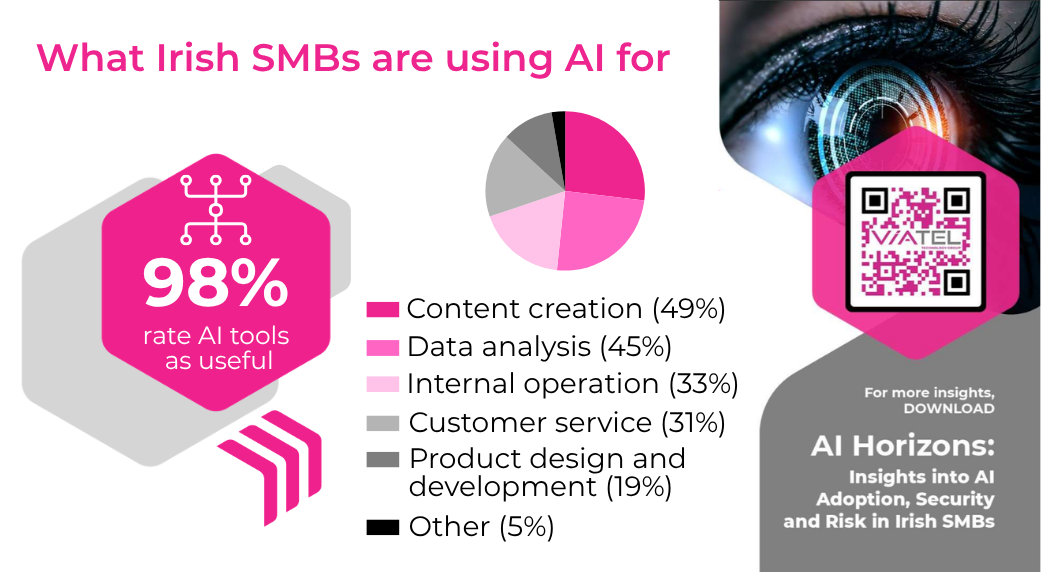
Viatel’s AI Horizons research say 80% of Irish SMBs anticipate some level of AI adoption within the next 12 months, most are still in early stages
Barriers to adoption remain significant:
- 95% report challenges, with security leading the concern
- 87% lack a formal AI policy
- Only 5% have a defined roadmap with budget and timelines
In practice, many organisations are already using tools like Microsoft Copilot and ChatGPT to support:
- Content creation and drafting
- Data analysis and insights
- Internal operations
- Customer service
Real – World Example: AI in Practise
The opportunity is clear, but so is the need for structure. Without governance, ownership and clear policies, AI adoption can quickly become fragmented. The businesses who are seeing the most impact are those applying AI with discipline.
A strong example is BowelScreen Ireland , where Viatel delivered a secure, scalable Azure-based solution to support anonymised data for the EU-funded micro-AI-ome project.
The takeaway extends beyond healthcare, successful AI initiatives depend on secure infrastructure, clear governance and a well-defined business case.
Internally, at Viatel, this has been a deliberate approach. Rather than advising from the outside, the organisation adopted AI internally first, positioning itself as “Customer Zero” and testing what works in practice before bringing those learnings to customers.
As Eilish O’Connor, Director of Strategy & AI CTO at Viatel Technology Group, explains:
For us, being Customer Zero was about getting hands-on with AI ourselves first. We wanted to understand where it could genuinely add value, where the risks were, and what was needed to roll it out properly across the business. We started with practical use cases, built the right governance and security around it, and learned as we went
Read how Viatel approached AI as Customer Zero
What Can AI Do for My Business?
Most businesses do not need a long list of futuristic use cases. Instead, they need to know where AI can deliver measurable value first.
- Content creation and marketing
AI can help teams produce first drafts, campaign variations, summaries and internal materials faster. In a Generative AI business context, the gain is speed, but the bigger benefit is freeing skilled people to focus on judgement and strategy. - Customer service automation
AI can support high-volume customer interactions, triage common queries and improve response consistency. - Data analysis and reporting
AI can help leadership teams surface patterns, compare scenarios and shorten the distance between data and action. That is where AI for productivity becomes commercially useful. - Internal productivity tools
AI can support meeting summaries, document drafting, search and workflow support. For many organisations, this is where AI transformation starts because the gains are immediate and visible.
The AI Adoption Journey: Where to Start
Businesses should approach AI adoption as a structured business programme, not a one-off technology deployment.
- Secure and prepare
Before deployment, organisations need to ensure their environment is ready. This includes reviewing identity and access, data governance, permissions and security controls to reduce exposure and ensure AI is introduced in a controlled and compliant way - Enable and adopt
Access to AI tools does not drive value on its own. Teams need clear guidance on how to use them in practice. This means structured training, role-based use cases and practical examples aligned to real business scenarios, so AI becomes part of everyday workflows rather than a standalone tool. - Measure and scale
AI adoption should be driven by outcomes, not usage. Organisations need to track how AI is being used, identify where it is delivering value and expand adoption based on measurable results. This ensures investment remains focused on high-impact areas rather than broad, unfocused rollout.
Importantly, it also addresses a key challenge in the Irish market. While AI adoption is increasing, very few organisations have a defined roadmap in place, which limits their ability to move from experimentation to meaningful, organisation-wide impact.
What Does a Successful AI Strategy Look Like?
At this stage, successful organisations are asking sharper questions:
- Which use cases will deliver measurable value within the next 6 to 12 months?
- What data security and governance controls need to be in place first?
- Where does human oversight remain essential?
- How will success be measured beyond activity or usage?
Viatel’s AI Solutions Suite reflects that logic. It focuses on executive understanding, current usage and governance, identifying opportunities and building a balanced scorecard so initiatives stay measurable and aligned to business goals.
AI Governance, Security and Risk Considerations
AI creates opportunities, but unmanaged AI creates exposure.
Viatel’s AI Horizons research identifies security as the number one barrier to adoption for Irish SMBs. Viatel’s AI Solutions Suite also places strong emphasis on understanding shadow AI, monitoring tools in use, seeing how data is being shared and identifying compliance or IP risk.
These are some of the more common challenges organisations need to manage:
- Sensitive data being entered into unapproved tools
- Outputs being used without proper review
- Teams adopting AI in different ways with no central visibility
- Governance lagging behind experimentation
AI Use Case | Business Impact | Risk if unmanaged |
Content and reporting | Faster output and improved consistency | Inaccurate or unverified outputs |
Customer service automation | Better responsiveness and service efficiency | Poor quality responses without oversight |
Data analysis | Faster insight and stronger decision support | Data exposure or flawed interpretation |
Internal productivity tools | Time savings and better workflow efficiency | Shadow AI use and compliance risk |
Click here to understand how Viatel supports AI governance, risk assessment and secure adoption
Why Do Businesses Need a Structured Approach to AI?
AI without structure can often lead to duplication, inconsistency and weaker returns.
Without structure, as teams adopt different AI tools, quality can vary, data handling can become inconsistent and shadow IT can take hold.
When AI use happens without approval, policy or a clear roadmap, leaders lose visibility over how data is being used, where risk is building and which use cases are delivering value. In turn, that makes it harder to scale what works, control what does not and keep investment aligned to business goals.
A structured approach solves that by creating:
- Alignment to business goals
- Visibility across use cases and tools
- Measurable success criteria
- A path to scalable adoption
Ultimately, this is why AI transformation should be treated as part of wider digital transformation. It shapes process design, governance and leadership accountability. It is not just another technology purchase.
Is AI a Strategic Opportunity for Businesses?
AI is now part of modern business strategy. It is no longer just a technology upgrade, it is a way to improve performance, efficiency and decision making across the organisation.
In practise, the value of AI will vary by business:
- Productivity gains through tools that support day-to-day work
- Automation and efficiency across operations and workflows
- Advanced data analysis to inform better decisions
- Improved customer experience through faster, more personalised interactions
The key question for every organisation is the same:
How can AI be adopted in a way that improves performance without introducing risk or losing control?
This is why a structured approach matters. While rushed adoption can create challenges, denying AI is no longer a viable option. Businesses near clear ownership, governance and a defined roadmap to unlock value safely.
AI is already transforming how businesses operate, but knowing where to start is often the biggest challenge.